
Showing posts with label php. Show all posts

Sunday, November 17, 2019

Laravel vs Symfony: PHP Framework Comparison

Laravel vs Symfony: PHP Framework Comparison
Choosing a good PHP framework provides the right building blocks to make developing your app a breeze. Today we’re going to look at two PHP frameworks: Laravel and Symfony.
We’ll compare them, score them, and declare a winner. Along the way, you’ll choose the framework that’s right for you and your product.

Laravel vs Symfony: PHP Framework Comparison

PHP Framework Similarities

Both Symfony and Laravel provide cross-platform PHP frameworks and features that speed up the development of your PHP application. The scaffolding of the application helps define its structure, and the plugins extend your ability to add features quickly.
From a baseline perspective, both options start in a good place. What differentiates the two, however, depends on the specific application and developer needs.

PHP Framework Differences

It’s easiest to define differences by categorizing similar features and benefits. Once categorized, a series of questions start to emerge. Answer these questions, and the best option for your specific application should distinguish itself.

New call-to-action

Popularity

Though you shouldn’t choose a PHP framework on popularity alone, there are some benefits a large user-base brings to a framework.
Laravel is the most popular PHP framework, but Symfony still ends up high on the list at number two.
With popularity comes a large amount of training and support information online. For Laravel, tutorials through Laracasts can provide excellent information that Symfony currently doesn’t provide. Though Symfony still shares great documentation, the resources are not as extensive as those for Laravel.
Laravel: 1 
Symfony: 0

Performance

In older versions, Laravel performed better than Symfony.
However, with improvements in Symfony 4+, Laravel’s edge shrunk down close to nothing. The performance gains that Laravel once boasted might not be there anymore.
As long as you’re using the latest and greatest version of each PHP framework, performance is a toss-up. Therefore, there’s no change in score.
Laravel: 1 
Symfony: 0
PHP Framework Performance

Modularity and scaling

Symfony contains reusable components, which provide more modularity. It cleanly organizes the code, making it a great fit for larger and more complex projects. This is why many experienced PHP developers prefer Symfony over Laravel.
Additionally, Laravel’s strength revolves around MVC-based apps. Once you start to wander away from the MVC paradigm, Laravel can’t help you.
Using Laravel to get up and running will leave your Symfony cohorts in the dust thanks to a useful set of pre-built dependencies that you’ll need. However, if you’re building a large scale application, picking and choosing your dependencies and plugins makes the application easier to enhance and scale. For this section, the point goes to Symfony for flexibility and modularity.
Laravel: 1 
Symfony: 1
Pro Tip: As you begin to scale and projects become larger and more complex, consider using an APM tool like Retrace to help monitor code and identify errors in the pre-production pipeline.

Templating engine

PHP in itself is a templating engine.
However, providing additional templating engines provides more advanced templating with less syntax. Using other templating engines helps keep the business logic in the PHP and presentation logic within the templating engine.
While Symfony provides Twig as the default templating engine, Laravel provides a bit more.
Laravel’s default templating engine Blade has lots for everyone, Blade provides advantages over Twig, as it allows for code reusability that doesn’t exist in Twig. Additionally, Laravel brings in Lumen, a sub-framework for building APIs and microservices. Bonus!
Laravel: 2 
Symfony: 1
Templating Engine

Database support

Both Laravel and Symfony provide object-relational mapping (ORM) for data access. With Symfony, Doctrine handles ORM, while Eloquent provides ORM for Laravel. With ORM, data manipulation becomes much simpler in either PHP framework.
There are many database-related differences between the two PHP frameworks.
Out-of-the-box support
First, let’s look at what databases each PHP framework supports.
DatabaseLaravelSymfony
DrizzleX
MySQLXX
OracleX
PostgreSQLXX
SAP Sybase SQL AnywhereX
SQLiteXX
SQLServerXX
As you can see with the table, Symfony provides a few additional options. So, if you’re going for breadth, Symfony wins this one.
Database migrations
With Symfony, database migrations are automatic. They just need simple definitions for the fields in the model. So that seems like a quick win, but let’s look further. When considering Laravel, database migrations are manual, but they don’t require defining the fields!
Data modelling
With Laravel, accessing the data requires more knowledge of SQL. That’s not the case with Symfony, although it requires that you create a repository function for each call. If your application uses a complicated database structure, that may result in a large number of repository functions.
On the other hand, Eloquent tends to tie your application to your DB schema design. Changing a column name could result in changes throughout your codebase. Doctrine, and Symfony, by extension, use a mapper pattern, so you can delineate between your database schema and your business objects and logic.
Taking all of that data into account, I’m going to go with Symfony for this
Laravel: 2 
Symfony: 2
FYI: If your app relies on a database, you know that problems in the database often have a wide-reaching impact downstream. Retrace’s SQL Monitors are a great way to more proactively keep tabs on data and database health.

Final score

There’s not a particular technology that’s better across the board.
It all depends on what problems you have and which technology can best solve those problems.
Try both to see which works best for your use case. Experiment and play with the features that are most important to you.
In either case, you can use Retrace to monitor your PHP app. Head on over to the getting started section to see how easy it is to set up.
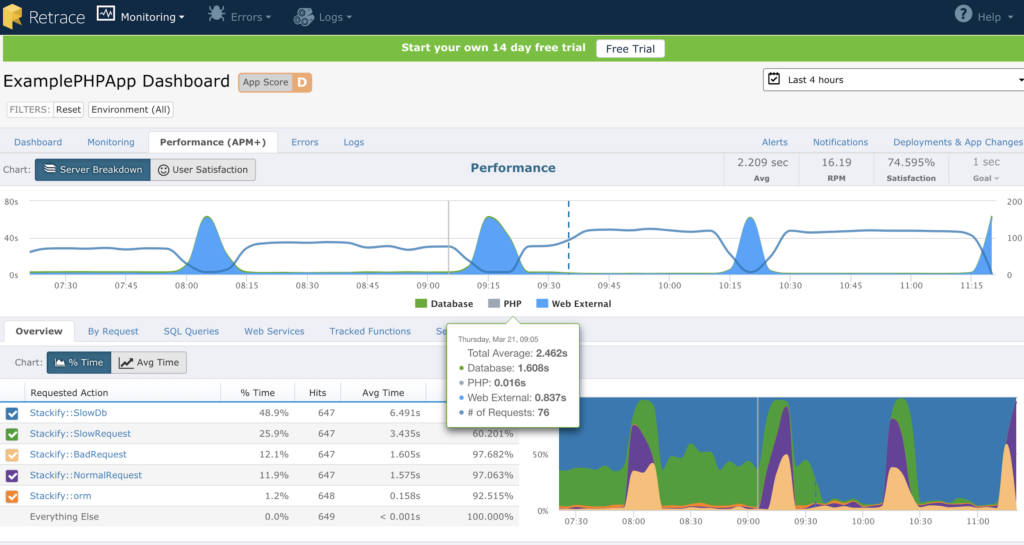
Retrace

PHP vs Python: Which Should You Choose in 2019?

PHP vs. Python: Which Should You Choose in 2019?
There are dozens of great languages to learn. Today we’ll be breaking down the differences between two of the best: PHP vs Python. Which one is best for your application? Which is going to give you the best return on your development time?
We’ll put these two head-to-head and find out which is the best choice for you.

Ease of Installation

If you’re building a small application by yourself, PHP has three simple advantages.
Installation is a breeze. It runs well on Windows (native or WSL), OS X, and Linux, and can be found on a variety of shared hosting sites around the world, usually for a minimal fee.
Installing Python can be a difficult proposition. If you’re on OS X, there’s an existing system version of Python that came installed on your computer.
Bad news.
It’s outdated and not suitable for application development.
Trust me, you don’t want to install new packages on the system Python. You’ll need to install a new version to make sure your system is as stable as possible.
Python on Windows can also take a bit of work to install.
The most common advice is to use a Windows package manager like Chocolatey as you start out. If you’re planning for a team, that little bit of extra work can add up.
If your team’s on Linux, though, you’ll have no problems installing Python.
PHP wins this round on account of being easier to install pretty much everywhere.
Score: PHP 1, Python 0

Library Management

Python has a strong advantage over PHP.
Python uses Pip (a recursive acronym that stands for “Pip Installs Python”) to manage packages. Pip makes managing different libraries within a Python application simple, it’s fast, and your project’s requirements are easy to parse at a glance. As a Python developer, Pip is an essential tool to have in your toolbag.
PHP’s library management isn’t as strong.
PHP 7 introduced Composer, which is a fantastic tool, mostly feature complete, and (when paired with a tool like Packagist), you’ll find package management close to on-par with Python’s. Unfortunately, it’s still pretty young.  
At the end of the day, Python has a broader variety of mature packages, and their tools are a bit easier to install and use at this time.
One point for Python.
Score: PHP 1, Python 1

New call-to-action

Environment Management

If you build your applications entirely on containers using something like Docker, you probably don’t need to worry about environmental management. So, congratulations! Move right along.
If that doesn’t describe you though, being able to segregate your application’s installed language and library versions is a critical part of staying sane as a developer.
Python, again, has a best of breed application to manage environments. Virtualenv is a system used to install multiple versions of Python side by side and switch between them quickly. Virtualenv is one of the original environment managers and has been actively maintained for more than a decade. It’s a terrific piece of software.
PHP isn’t so lucky. There is an analogue for virtualenv for PHP called virtPHP,. but that project has been archived and is no longer actively maintained. Their own developers actually suggest using containers instead.
This is wise advice as containers have all sorts of advantages for developers and operational deployment. Unfortunately, they’re not a great fit for every environment. If your environment is one of those, PHP is at a disadvantage here.
Python scores another point.
Score: PHP 1, Python 2

Easy to Learn

Python and PHP are very similar. Both are object-oriented interpreted languages that run on a variety of operating systems. They’re both dynamically typed and have terrific IDE support. Lastly, Python and PHP both stand out in the world of syntax.
PHP requires that you prefix all variables with a $ sign, and uses the -> operator to indicate a method called on an object. Those make it stand out from other C-style languages.
Python’s syntax is dissimilar from many other languages. It disposes of curly braces and instead it embraces whitespace sensitivity.
So, which is easier to learn?
That’s tough to say.
PHP has some advantages. PHP has a double-edged sword in their array concept, which serves as something like a combination between Python’s list and dictionary data types. It’s a benefit because if you understand how to use an array, you can do a lot in PHP. However, it’s also a negative because PHP often lacks quality implementations of other more focused data types.
If you’re trying to do something that doesn’t fit into an array, using PHP means you might need to write your own data type.
In Python, that’s not the case.
Python has a wide variety of built-in data types that are ready to go right out of the box. The challenge with Python is often knowing which tool to use for the specific job that you’re doing. That’s still a challenge, but it’s usually an easier one to solve. Python does have a disadvantage that the Python 2 to Python 3 transition has not been backwards compatible.
One more quick word about learning PHP: it’s an old language. That means there are a lot of outdated, and frankly bad, tutorials out there. That’s a real impediment to learning the language from scratch.
Despite that, both score in this category.
Score: PHP 2, Python 3

Application Speed

Many of the things that make web applications slow aren’t related to programming languages at all. Slow database queries bog down every programming language. Relying on excessive network queries or reading a lot of information from a disk will slow you down every time. That said, in most circumstances, PHP is a faster programming language than Python.
The core PHP team has done a great deal to speed up PHP, and with PHP 7, they succeeded.
That evaluation doesn’t come without caveats though. PHP famously restarts your entire application every time a web request starts. For the most part, that’s not a problem. However, it can be trouble if you’re working with an application that needs to share resources across requests.
Because PHP sets up and tears down the entire application on every request, sharing resources can be difficult. That’s not as much of a problem for Python, and in fairness, it’s something that most web applications don’t need to do.
It’s also important to remember that no matter the language, you’re not guaranteed a fast web app. If you’re building a new web application and you’re looking for the best performance, you should plug into a tool like Retrace. It’ll help you identify problem spots within your application and speed them up no matter which language you choose.
PHP gets the point here.
Score: PHP 3, Python 3

PHP vs Python Conclusion

We’ve got a tie! Honestly, that feels about right. Both PHP 7 and Python 3 are excellent choices for building a web application in 2019.
So, when comparing PHP vs Python, which should you choose? Well, that depends on what you need.
Do you need to share environments on the same PC? Python is almost certainly the right answer. Are there developers on your team who already know some PHP? PHP is probably your best bet! Does your application require great Unicode support? Python would be the way to go.
No matter which way you go, it’s not about PHP vs Python. The key is to get out there and get building. You can’t make a wrong decision here. Best of luck building your new application!

Functional Programming vs. Object Oriented Programming


In current development, Object Oriented Programming has proven more popular than its predecessor Functional Programming.  Functional Programming was developed before Object-Oriented Programming, with support for Lisp, Clojure, Wolfram, Erlang, Haskel, F#, and R.  Object Oriented Programming is more modern with support for C++, C#JavaPythonRubyPHP, Perl, Objective-C, Swift, and Dart.  With the increasing popularity of JavaScript, Functional Programming is experiencing a resurgence in popularity.

Definition

Functional Programming treats programs as functions and is assigned using a mix of recursions. Object-Oriented Programming is a convolution of cooperating objects. Every object inside the program can receive a message, process data, or send messages to other objects. In Functional Programming, the function is the primary unit that can be changed. In Object-Oriented Programming, the object is the primary unit that can be changed.

Method

With Object-Oriented Programming, everything is imperatively described with the code describing how the program works. The commands go through the machine, statements are executed and then appear in the right order. If the order is not right, the program will not run.
Functional Programming utilizes more flexible declarative programming. In Object-Oriented Programming, the command words would be: “You must do this” and the program would run smoothly. In functional programming, you could tell the program: “You should do this” without further specifications, and the program would run without any issues.

Data

Functional Programming is a more “flexible” approach, with mutable objects. These objects can be changed, even after they have been created. In contrast, Object-Oriented Programming uses immutable objects that cannot be altered.  
While Functional Programming and Object-Oriented Programming use mutable and immutable objects, they do have a type. Mutable fields can be changed after object creation and have a method for modifying the field value. Immutable objects cannot be changed after object creation and method for modifying the field value does not exist.

Drawing a parallel

Parallel Programming is defined as the calculations or the execution of processes carried out simultaneously.  Functional Programming supports Parallel Programming, while Object-Oriented Programming does not.
Parallel Programming is a separate branch of programming where special methods are used to separate algorithms into their basic parts.  The methods are performed on several machines or CPUs at the same time. Hence the term, parallel.
By using Parallel Programming, computing time is significantly reduced with quicker results compared to that of Non-Parallel Programming. Although, at times, Parallel Programming is not always the most time-efficient programming method and a different method is needed. 

Paradigm

The programming paradigm is the execution or “philosophy” of certain programming languages.  With this, the programming languages have been separated into two basic groups: imperative languages and declarative languages.
The basic divisions are further broken down into Structural or Classic “Imperative” Programming, Logical Programming, Functional Programming, and Object-Oriented Programming.
Structural Programming is often thought of as the introduction into programming as it commands your machine through branching and cycles.  Logical Programming is most often used in artificial intelligence development with problems explained in detail. Functional programming is defined as a function.  Object-Oriented Programming interprets real-world issues and situations and is the most popular programming method in current development.  

Iteration

Iteration serves as an additional difference between distinctive between Functional Programming and Object-Oriented Programming. Iteration can best be defined as something that is repeated several times, to get close to the same result or goal. 
Every kind of repetition in programming is called iteration. More specifically, the repetition of command blocks. When one iteration ends, the results from it are used as a starting point for the next iteration, and so on.
Below is an example of an iteration:
a = 0
for i from 1 to 3        // goes through the loop 3 times
{
  a = a + i              // current value sized up for i
}
print a 
Functional programming uses recursion for iterative data, whereas Object-Oriented Programming uses loops. Recursion is an infinite, scaling repetition of the same pattern – ascending or descending. The method in the program will be called each time the program is executed.
Iterations (loops) are the instructions in a program that are executed over and over again. Iterations are always applied to a set of certain instructions while recursions are always related to a method.
If a  recursion does not have a brake or condition, it will result in blocking the computer by using all of its resources. In contrast, if a variable is not terminated, the iteration will last indefinitely. Functional Programming tends to be more compact than Object-Oriented Programming with recursions making code a bit shorter and iterations making it longer. 

Use

There are no definitive rulings for when to use Functional Programming and when to use Object-Oriented Programming.  At times, Object-Oriented Programming is not the cleanest way to program. To reach a perfect solution, software developers can over-engineer their code.  Functional Programming can prove difficult for junior developers to understand and execute.  
Object-Oriented Programming and Functional Programming are not mutually exclusive.  Popular programming languages, such as Swift and Scala, mix the two programming methodologies. 

The resurgence of Functional Programming with Popularity of JavaScript

Functional Programming has made it’s a big comeback with the popularity of JavaScript and its component-based pattern libraries, such as Angular, Vue and React.  React, for example, has a functional-based design and the objects in it are immutable. 
JavaScript has first-class functions and can be passed like any other values. That means that a function can be passed to another function, which makes higher-order functions. They are mostly used to abstract actions, async flow control, and create utilities.

Conclusion

With differences in their definitions, methods, and uses, Object-Oriented Programming is more popular in current development than its precursor Functional Programming.  But, Functional Programming is experiencing a resurgence with the increasing popularity of JavaScript and languages such as Swift and Scala combining the two programming methodologies.

Most popular PHP frameworks: Which Should You Choose?


PHP is the most popular scripting language for backend web development. One of the reasons why PHP has retained its position as the top server-side management language is its advanced frameworks. PHP frameworks are web-oriented, meaning that they help developers build web applications more productively.
In other words, they provide you with a base for the application which can be customized to match your requirements and needs.
Additionally, frameworks such as LaravelCodeIgniterSymfony, and others are here to make your web development more efficient, improve scalability (adapting to the growing size of your application), guarantee stability and safety, and prevent repetitive code production.

    Briefly: what is a PHP framework?

    Before starting the PHP framework comparison, it is important to define frameworks and their advantages for web development or other programming areas.
    Programming languages are limited to a certain number of functions or features. To perform actions, you need to write code, find errors, and check whether it fulfils your vision. A framework is a shortcut: you use code provided by someone else. Therefore, instead of having to produce code manually, you take resources from the framework.
    PHP frameworks refer to pre-written collections of PHP code that you can use in your project immediately. It is usually the base of applications. Developers further enhance the features themselves, giving the project a unique look.
    However, since there are so many PHP libraries to choose from, we aim to discuss the five best PHP frameworks to help you make your decision.

    Laravel

    Without a doubt, the Laravel framework is the most popular for PHP developers. Ahead of its pack, Laravel ranked as the 10th most popular web framework in 2019. Even though this framework was created in 2011, it managed to climb the ladder to success quickly.
    Laravel is an open-source framework, capable of assisting in the production of both small and large PHP projects. It is mostly praised for following the MVC (Model View Controller) architecture, which lets you separate the application into parts, so it does not get confusing.
    PHP Frameworks: Laravel
    This arrangement is the same as separating HTML from CSS, so the code would not get cluttered and more difficult to follow.

    MVC Architecture

    In fact, most of the PHP frameworks have adopted the MVC architecture, which divides applications into parts called model, view, and controller:
    • The model is the data layer, meaning that it consists of all the data your application controls. The model is the one that retrieves information from a database, puts it in data objects, and transfers them to the targeted location. A simpler explanation is that the model part of the website secures all of its data, processes it, and transfers this information to the end-user.
    • The controller is the place that the application communicates with its users. It is standard that the controller accepts requests from the interface and sends data to the model. The model processes data and sends it back to the controller. Then, the controller transfers the results to the view.
    • The view is the part of the website, which finally presents data to the end-user after selecting and organizing the information.
    Due to the convenient arrangement of application data, many programmers choose to create programs that follow the MVC architecture. Since creating such websites can be complex, PHP frameworks provide the essential elements to start with.

    Advantages of using Laravel

    Coming back to the Laravel framework, here is a list of features and benefits that you can get:
    • Laravel offers lightweight templates that developers can use as a base for their website. These templates can be customized according to developers’ needs.
    • One important characteristic of the Laravel framework is that it helps you create secure websites. For instance, it prevents SQL injection for users that apply Fluent Query Builder or Eloquent. SQL injections are one of the most dangerous attacks (and oldest) on the web when hackers taint SQL statements with malicious code and send it through the web page input. The result of such attacks is that confidential information might be stolenchanged, or that hackers can access the operating systems via the database server. Therefore, it is a good thing that Laravel offers protection against SQL injections.
    • Eloquent works by improving the way developers manage records in their servers. It automatically transforms table columns into PHP class properties. Therefore, you will be able to update, delete, and add new data to your database without using SQL.
    • A built-in feature is Artisan, helping developers manage repetitive tasks. It makes it easy to write the base for the database structure and handle the migration aspect. Therefore, developers can manage their database systems more efficiently.
    • Usually, developers need to produce SQL queries for creating table structures. The Laravel framework uses migration instead. It is similar to Git or other project-management systems that let you revert to the older versions of your project.
    • Laravel also makes it easy to secure your website with authentication. This feature highly speeds up the process as Laravel sets authentication with a single line while pure PHP code would take more lines of code (and work).
    All in all, you should not be surprised that the Laravel framework is the most popular in the business and even considered as the best PHP framework. It secures websites, makes it easier to manage information in databases, improves scalability, lets you revert to older versions of your project, and, overall, makes the backend web development more enjoyable.

    CodeIgniter

    CodeIgniter is a PHP MVC framework that also stands out from the rest with its capabilities to guarantee a better web application performance thanks to smaller code volume.
    PHP Frameworks: CodeIgniter
    It offers fewer features than Laravel. For instance, CodeIgniter does not have built-in authentication or debugging tools. Therefore, developers need to write code manually.
    Sometimes fewer-features translates as more beginner-friendly but we can look at this from a different perspective. Exploring richer PHP frameworks might take longer, but you will be able to exploit more pre-written code for your project. As a result, you won’t have to write as much code yourself.

    Why should you choose CodeIgniter?

    However, we are not stating that CodeIgniter is not a solid option. Here are the main arguments for choosing this framework as your guide:
    • It helps to produce web applications that excel in the performance aspect. CodeIgniter achieves high-speed because it is lightweight as the main system needs only a couple of small libraries.
    • The high-performance of CodeIgniter is also related to the fact that this framework does not require developers to use a template engine (a way of embedding backend code into HTML). Since PHP has a built-in feature of embedding code, CodeIgniter believes that the use of additional parsers is unnecessary. Therefore, the web application works faster as there is no need to convert the PHP code.
    • This framework also follows the MVC architecture, letting you separate different parts of your website for better management.
    • CodeIgniter has explicit documentation, letting beginners learn from official and trustworthy sources.
    • CodeIgniter makes sure that URLs are short and more SEO-friendly. Routing refers to the way you set URLs to open a specific page. If a URL does not have a route, it leads to a 404 (not found) error.
    • If you find yourself wanting more, CodeIgniter can improve with additional add-ons that provide more features.
    • CodeIgniter has Cross-Site Scripting filtering for preventing Cross-Site Request Forgery (CSRF). Such attacks occur when hackers exploit information on websites that users already have authentication.

    Continue learning

    If you want to continue learning about CodeIgniter and the way it is used for web development, we recommend checking out our course on this exact topic. Overall, CodeIgnitor is lightweight, does not have many overwhelming features, and helps developers create high-speed web applications. Therefore, it is one of the best PHP frameworks for beginners that do not intend to use more complex features of, for instance, Laravel. This course will help you create web applications with PHP, Bootstrap, and the CodeIgniter framework.

    Symfony

    The PHP Symfony framework also provides pre-written code for PHP developers. It is highly-useful for large-scale projects, but the framework mostly targets people that have more programming experience.
    PHP Frameworks: Symfony
    • Therefore, Symfony might not be the best option for beginners that are only starting to master PHP and its quirks.
    • This PHP framework is one of the best for large-scale projects.
    • PHP Symfony framework offers an easy way of localizing websites and translating interfaces. Therefore, your web application is very adaptable as you will be able to provide, let’s say, English and French versions of your website.
    • Symfony offers an SEO-friendly routing system.
    • Furthermore, Simfony supports the feature of bundles (similar to plugins), which contain code you intend to reuse for multiple projects. For instance, if you happen to be building an e-Commerce website, you will avoid writing the same code for the next e-Commerce project.
    • Symfony also follows the MVC architecture and lets developers divide their web applications into separate sections for better management.
    Specialists indicate that it is one of the fastest PHP frameworks. One important tip is to make sure that your application uses PHP 7. This conversion can boost your app speed by 50%. You should follow this advice for every framework mentioned as the PHP 7 introduced many significant improvements, including enhancement of speed.

    Zend

    Zend is an open-source framework that follows the explained MVC architecture. It will help you create a basic structure for your web application.
    The framework is a bit more challenging to learn when compared to Laravel. Therefore, Zend is not as popular since developers have to put more effort to use it properly. Due to its complexity, Zend might not always offer the best performance, but developers mention it among the fast PHP frameworks.
    PHP Frameworks: Zend
    The framework has been responsible for the creation of a wide variety of PHP applications ranging from e-Commerce platforms to healthcare systems and entertainment portals. Here are the main features of Zend:
    • It is fully object-oriented. Therefore, the framework follows the basic concepts of object-oriented programmings, such as inheritance and interfacing. This feature increases the reusability of code and makes the web development faster.
    • New bits of code need to be checked with specific unit tests (using PHPUnit).
    • The framework offers many components from classes to objects that are for implementing specific features in your web application.
    • It offers great reusability of code since you can make one module inherit properties of other modules and pass the same methods and attributes.
    In 2019, it was announced that Zend is becoming an open-source project of the Linux Foundation. The project will be renamed to Laminas.

    FuelPHP

    FuelPHP framework is also an open-source library introduced in 2011. The creators of this framework want it to be community-driven, meaning that basically anyone can become a contributor. Anyone can report bugs or fix them as well.
    The framework follows the HMVC model, which is similar to the regular MVC model. One of the differences is that the controller must choose the model before the view.
    PHP Frameworks: FuelPHP
    The model prevents the view from accessing the data directly by using an additional authorization step. Furthermore, the HMVC model provides an easier way of showing the same content on multiple pages. This feature results in lower memory usage. One of the most significant advantages of using HMVC is the digitization of content structures.
    Modularity is one of the strongest advantages of FuelPHP. The framework lets developers divide bigger projects into smaller parts referred to as modules. Even though you might develop these modules individually, combining them won’t be difficult. It is also easy to reuse your modules.

    Slim

    Slim, as it might be implied from its title, is one of the most lightweight PHP frameworks. Differently than the others, Slim does not follow the MVC model. Its purpose is to help developers produce web applications and APIs. Slim is also one of the frameworks referred to as “micro.” The concept of micro frameworks means that a library consists of the bare essential resources for creating a web app.
    PHP Frameworks: Slim
    Therefore, most PHP developers should be well-aware of Laravel and Symfony but less familiar with Slim. The reason for not knowing about Slim refers to the fact that programmers usually want frameworks that are large and full-stack. Slim does not offer a huge codebase, which might be a disadvantage for some. However, it does provide enough for producing simple but powerful APIs.
    Thanks to its simplicity, using the Slim PHP framework guarantees the fast development of applications. It supports all HTTP methods, manages URL structure with routers, middlewares, flash messages, encrypted cookies, etc.

    Conclusions

    Let’s make conclusions of this PHP framework comparison based on several factors:
    • Which PHP framework is best for beginners.
    • The best for e-Commerce web applications.
    • The choice for speed-sensitive applications.
    For beginners, it might be best to choose between Laravel and CodeIgniter. To be clear, we are considering beginners people that know how PHP works, but have not tried to use any frameworks yet. Since these two frameworks are the most popular PHP frameworks, beginners will quickly find tutorials and other useful tips. Additionally, they are excellent choices for starting to work with MVC architecture.
    For building e-Commerce websites, it is best to choose Laravel unless your client or company insists that you use a different framework. Laravel is easy-to-use but offers an array of features consisting of high-level security measures that protect websites from hackers.
    When it comes to speed, it is best to choose lightweight PHP frameworks such as CodeIgniter or Slim. However, we like to direct your attention to one aspect: the speed of development is also very important when it comes to producing web applications. Therefore, it is best to choose the framework that you are the most comfortable with. You cannot decide this without exploring them and seeing how they work.